07Websites and digital assetsReal estate and finance
Signal Kalkali
an economic briefing in Hebrew for 34 countries
signaleconomy.co.il
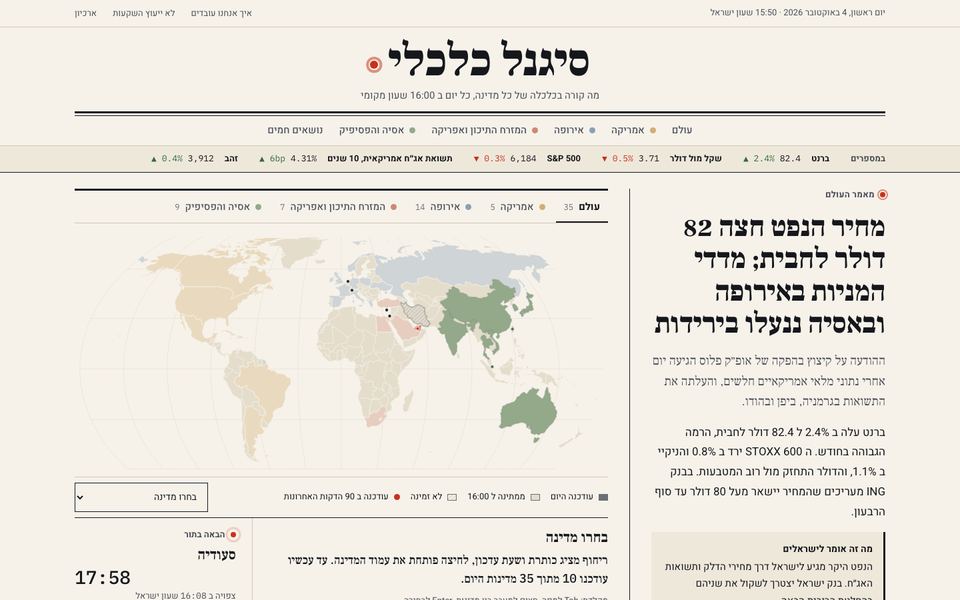
A Hebrew site that sums up what happened in each country's economy on a given day, with a piece for each region and one for the world, and a link to the source behind every sentence.
Five launch days, 185 articles that passed review
The challenge
Readers of Israel's business press get no daily Hebrew picture of what is going on in other economies. A site like that is written at volume, dozens of articles a day, which is exactly the profile Google treats as mass produced content. On top of that, the point is for people to rely on it. The bar was set before anything was written: not one wrong figure on the site.
What I did
- Wrote a binding source policy before the first article. A source qualifies only if its robots file allows it, there is no paywall, and the full article body can be read. Technical blocks are never worked around. The first audit left 166 qualifying sources out of 202, and most of the world's big financial papers were ruled out. Market data in the numbers box comes only from official sources: central banks, finance ministries, statistics offices.
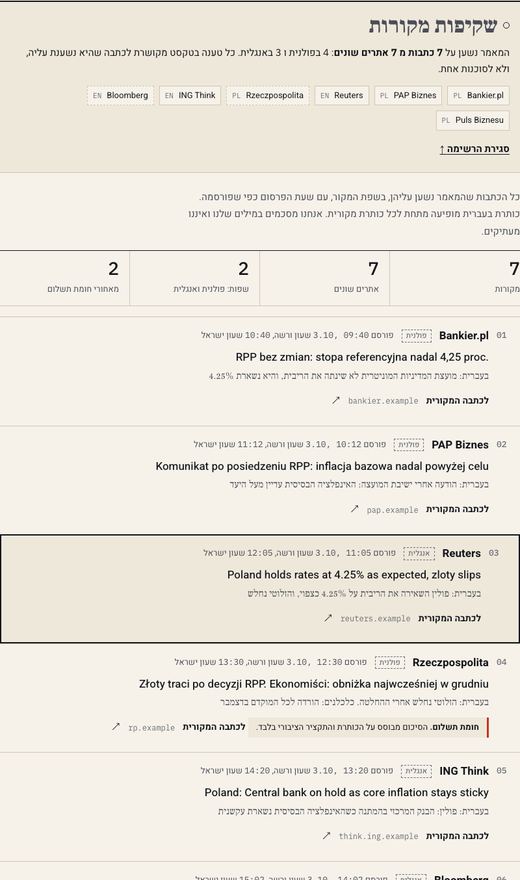
- Built a writing pipeline with AI tools, gated by code. Every article has a claims file: each sentence with a number, a name or a quote is tied to a verbatim passage from the original story. A checker confirms the passage really appears in the source, and a linter blocks known failure patterns before an article reaches the editor. An article that fails is not handed over.
- Added what the stories do not say: a "what this means for Israelis" section in every article, an analysis that builds a chain from a fact already in the piece, through a channel of influence, to the economy here. No new numbers and no forecasts. Where there is no plausible channel, one sentence says why. 157 articles had this section rewritten when the rule was set.
- Scanned every source URL for paywalls. Out of 1,163 URLs, 40 subscriber articles had slipped through unnoticed. I fixed the tool to detect and reject them, and cleaned 32 articles.
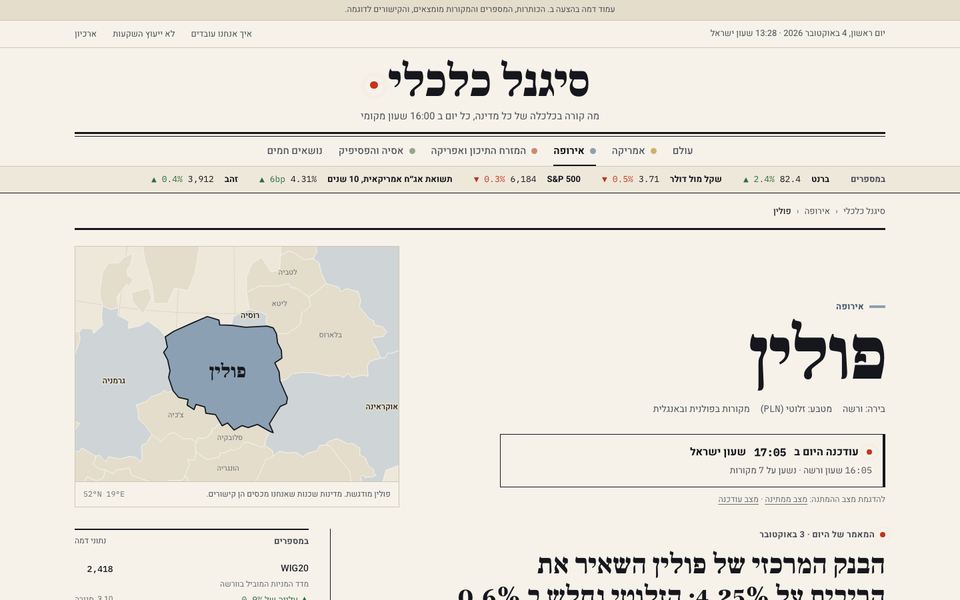
- Built the site itself: a newspaper style front page, a page for every country, region and topic, a source panel at the end of each article, and a back office to hide or remove an article.
The decision that made the difference
No sentence without a verbatim quote behind it. I decided figures are never checked against a summary from a fetching tool, only against the full text of the story, and that every claim is stored with its original passage. The reason: a site that publishes dozens of AI assisted articles a day can only hold trust if it can show, for every sentence, where it came from. That is also what separates a synthesis of sources from a rewrite of one story, the difference Google looks for.
What AI did, and what stayed with me
- The writing is done by a team of AI agents, in stages: a writer, an agent that works out what it means for Israelis, a quality checker, and a final review on a stronger model. Next to them sit code tools that verify every quote against the original story. Without that, dozens of articles a day across 34 countries would be out of reach for one person.
 The decisions about what counts as true were mine: the source policy, dropping any source that blocks AI tools instead of working around it, and making the Israel impact section real analysis rather than a stock sentence, a call that sent 157 articles back for a rewrite. I also decided the site does not cover Israel itself, because the country's major business news sites forbid AI use in their terms.
Outcome
- The site has been live on its own domain, signaleconomy.co.il, since October 5, 2026.
- In the five launch days, 185 country, region and world articles were written and passed review.
- 34 countries in four regions, plus topic pages that connect countries.
Link
signaleconomy.co.il (live, blocked from Google)