11Websites and digital assetsCulture and entertainment
Tkufat HaOsafim
an archive of the compilations released in Israel
osafim-archive.pages.dev
A Hebrew archive of the music compilations put out by Israeli record labels from 1958 to 2010, where you can search for a song and find which compilation it appeared on.
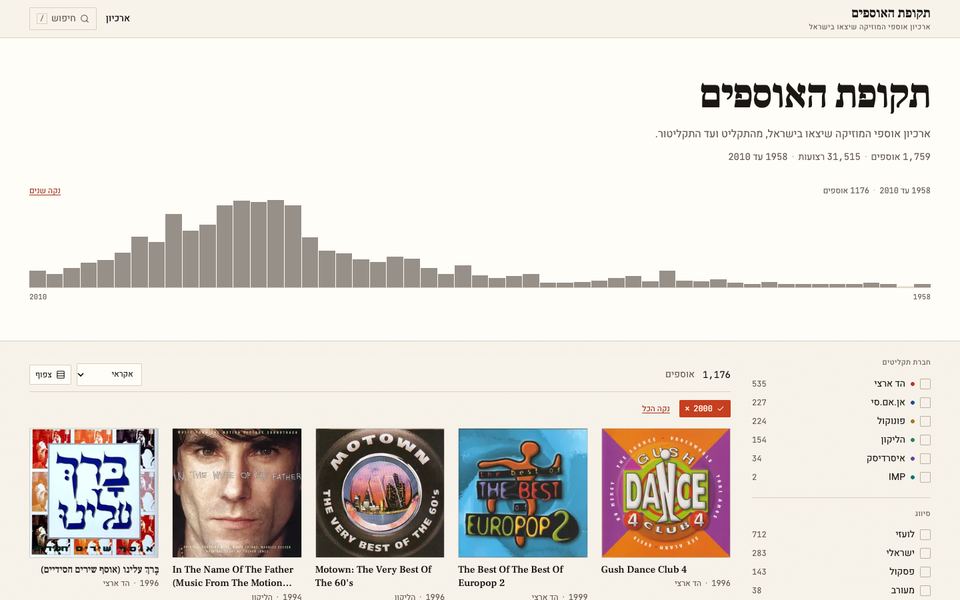
1,759 compilations and 31,515 tracks from six record labels, live and searchable
The challenge
People who grew up on "SuperMix" and the hit compilations from Hed Arzi, NMC, Phonokol and Helicon are asking one question today: which compilation was that song on. The information exists but it is scattered: in a long running collectors' blog that was written in Word and pasted onto the web, in a YouTube channel, and in the international Discogs database. Each source spells the series names differently, in Hebrew or in English, and none of them answers that question in a single search.
What I did
- Built an index first, and only then a site. A tracklist question is a database query, not a memory question. I pulled the blog's 547 posts and the channel's 125 videos, and parsed broken HTML: tags in the middle of words and line breaks splitting a single track in two.
- Scanned the Israeli labels' catalogs on Discogs, 20,060 releases, to find the compilations the blog never covered. That is where the site's titles, years, catalog numbers, tracklists and covers come from, and the blog fills in what Discogs lacks: the credits.
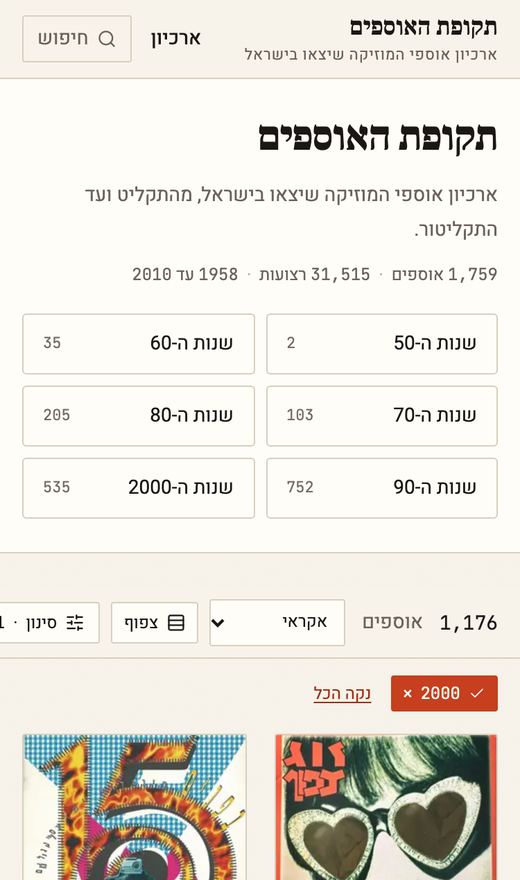
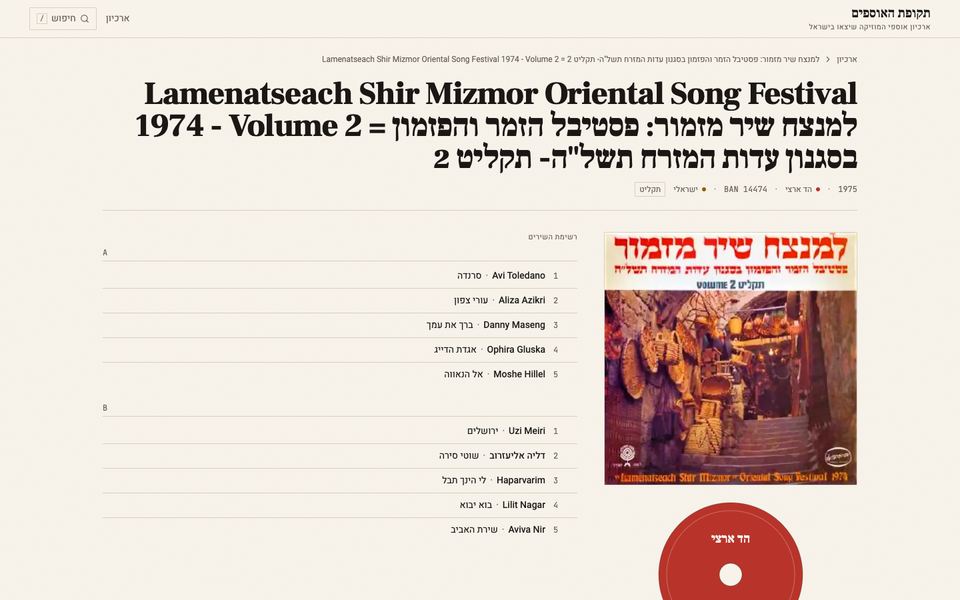
- Built the site: a grid of covers, a page for each compilation with the tracklist by side or disc, one search box that looks through compilations, songs and artists at once, and filters by decade, label, category and format that are kept in the URL so a filtered view can be shared. The front end skeleton was built with an AI site builder; the data, the filtering and the mobile fixes are my work on top of it.
- Wrote an honest sources page: where each field comes from, what was not checked against the physical copy, that the split into foreign, Israeli, soundtrack and mixed is computed and not error free, and that rights holders can ask for a cover to be removed.
The decision that made the difference
One Hebrew to English transliteration table that every tool uses. The blog writes "500% פיור דאנס" and Discogs writes "500% Pure Dance". Without a bridge between them, every such series counts as missing, a search for "סופרמיקס 4" does not find "SuperMix 4", and the video is not matched to its compilation. I decided this matching is infrastructure, not a one off fix, and that a YouTube link appears only when there is a certain match by series name, volume number and year. The reason: in a collectors' archive, one wrong link undoes trust in everything else.
What AI did, and what stayed with me
- AI did the heavy lifting on the data: it wrote the parser that pulls tracks out of the broken HTML of 547 posts, pulled the catalogs and built the front end skeleton. I also built an AI agent that answers the question "which compilation was this song on".
 I ruled that the agent never answers from memory, and that was the key decision: it has to query the index, because a tracklist question is a database query, not a knowledge question. I also ruled that a YouTube link appears only on a certain match, and that the sources page says openly what was not verified.
Outcome
- 1,759 compilations and 31,515 tracks from six record labels, 1958 to 2010.
- Music editor, producer and mix credits on about 350 compilations, documented from the physical copies and marked on the compilation page.
- 85 compilations linked to their video on YouTube.